HappyHorse 1.0: What We Actually Know
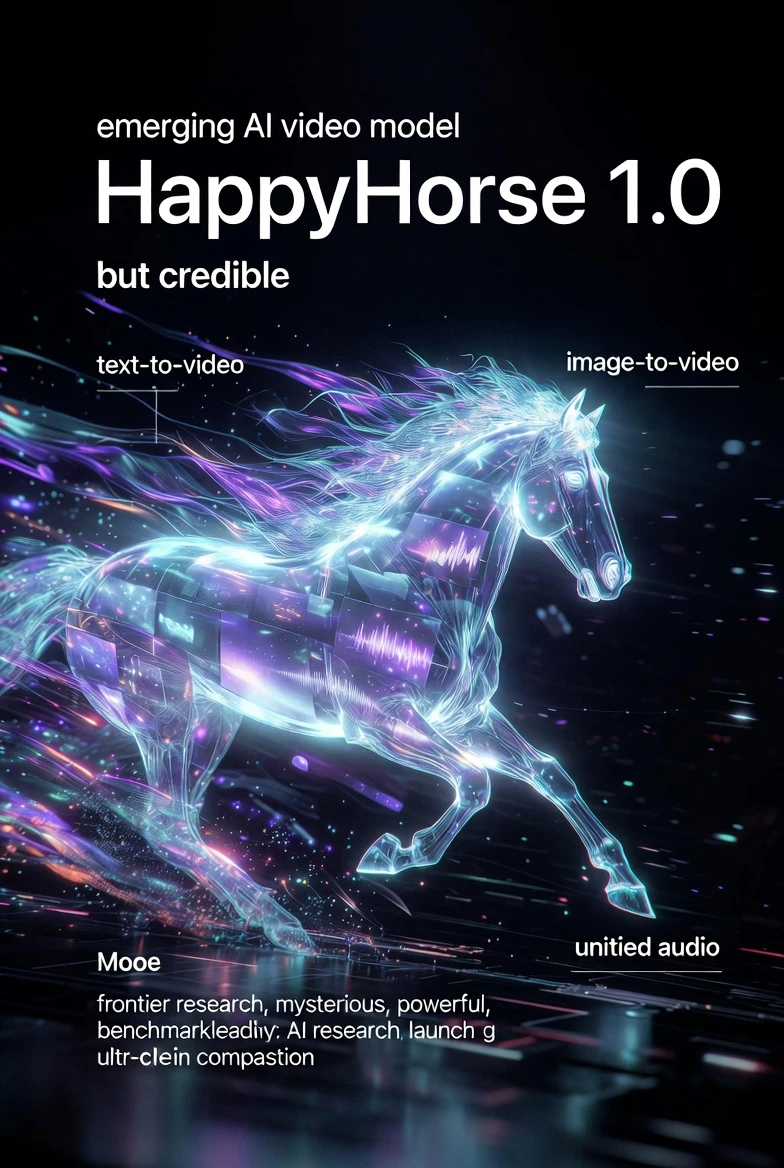
HappyHorse is no longer just a leaderboard mystery: the official product site is live, and Alibaba Cloud Model Studio now documents concrete HappyHorse 1.0 video model IDs and API behavior.

- →HappyHorse 1.0 is no longer just a rumor or leaderboard signal: the official product site is live at happyhorse.cn, and Alibaba Cloud Model Studio now documents HappyHorse 1.0 model IDs.
- →The documented model family includes text-to-video, image-to-video, reference-to-video, and video editing variants.
- →The Alibaba Cloud docs describe sound-enabled 720P/1080P MP4 outputs at 24 fps, with 3-15 second clips for HappyHorse 1.0 variants.
- →The image-to-video API reference confirms an asynchronous DashScope workflow: create a video synthesis task, then poll for the result.
- →This is a real status upgrade, but it is not the same as open weights, a public training report, or a self-hostable release.
- →The safest current framing is: official HappyHorse product site plus officially documented Alibaba Cloud video model, externally benchmarked by Artificial Analysis, with open-weight status still unverified.
Why everyone suddenly noticed HappyHorse
Most AI video models become visible in a familiar order: paper first, repo second, community demos third, rankings later. HappyHorse surfaced in almost the opposite way. What broke through first was not an official technical release, but benchmark and arena attention.
That matters because it explains the current confusion. People are hearing two different claims at once: first, that HappyHorse looks unusually strong; second, that nobody can point to a normal public release package. Both can be true at the same time. A model can be real, competitive, and still not be fully published in the open-source sense most practitioners expect.
What is actually public today
The cleanest public anchors are now split across three layers. The official HappyHorse product site is live at happyhorse.cn, Artificial Analysis still provides the external benchmark context, and Alibaba Cloud Model Studio provides official hosted-model documentation. That is a major change from the early-April situation, when the strongest public evidence was leaderboard visibility and attribution reporting.
The Model Studio guide lists HappyHorse 1.0 variants for text-to-video, image-to-video, reference-to-video, and video editing. It also documents sound-enabled MP4 output at 720P or 1080P, 24 fps, and 3-15 second clips. The image-to-video API reference goes further by showing the DashScope asynchronous call pattern: create a video synthesis task, then query the task result.
Current best description: an official AI video creation product and Alibaba Cloud hosted video model family with strong benchmark history, but not yet a verified open-weight release.
What changed by April 28, 2026
The practical update is that HappyHorse now has a public product entry point and is visible inside official Alibaba Cloud Model Studio documentation. That changes the adoption question from "is this only a rumor?" to "which path should users take: the HappyHorse product site, Alibaba Cloud API access, or later model artifacts if they appear?" For builders, the official site and API documentation matter more than another reposted leaderboard screenshot.
- ·The official product site at happyhorse.cn describes HappyHorse as an AI video creation platform for generating and editing videos.
- ·Documented model IDs include happyhorse-1.0-t2v, happyhorse-1.0-i2v, happyhorse-1.0-r2v, and happyhorse-1.0-video-edit.
- ·Alibaba Cloud documents 720P/1080P output, 24 fps MP4, sound-enabled generation, and 3-15 second clips for HappyHorse 1.0 variants.
- ·The image-to-video API reference uses the DashScope video synthesis endpoint and requires asynchronous task polling.
What changed on April 10, 2026
The most important update came one day after the original article timeline. On April 10, 2026, a HappyHorse account posted that the model belonged to Alibaba's ATH Innovation Business Unit, was still in internal testing, and had not officially launched. That same post also said the circulating so-called 'official websites' were not genuine.
Alibaba's official Weibo account then reinforced the same point later that day, saying Q HappyHorse came from its ATH Innovation Business Unit and that internal testing had already begun. This matters because it moves the story from attribution speculation to official ownership acknowledgment. But it still does not supply the missing release artifacts: no public GitHub repo, no model hub page, no weights, and no technical report were introduced alongside that acknowledgment.
- ·Ownership became clearer on April 10, 2026.
- ·Release status did not become complete on April 10, 2026.
- ·That was the right framing on April 10; by April 28, the framing should be updated to official cloud documentation exists, while open-weight release evidence remains separate.
Why people think HappyHorse is strong
The strongest public case comes from Artificial Analysis Video Arena. That matters more than social hype because the arena is designed around user preference judgments rather than vendor self-reporting. If a model climbs there quickly, it usually means viewers are repeatedly preferring its outputs against strong peers.
- ·Artificial Analysis is already tracking HappyHorse as a first-class model entry.
- ·Public reporting on April 8, 2026 described HappyHorse-1.0 as reaching the top tier in text-to-video and image-to-video rankings.
- ·Secondary reports attributed concrete ELO advantages over well-known peers such as Seedance, SkyReels, and Kling.
This does not prove every architectural claim people are making online. It does prove something narrower but still important: by early April 2026, HappyHorse had already crossed the threshold from rumor into measurable competitive signal.
Do not describe HappyHorse 1.0 as a fully released open-source or open-weight model just because the official product site and Alibaba Cloud API documentation are public. Those are real release signals for hosted usage, but weights, code, license, and reproducibility still need their own proof.
Why that distinction matters
For most model users, the phrase open source implies something concrete: a repository you can inspect, weights you can download, a license you can read, and a technical document you can evaluate. None of that has been cleanly confirmed for HappyHorse itself yet.
That does not reduce the model's importance. If anything, it increases the need for careful wording. Calling it "already open" would mislead readers who want to reproduce results. Calling it "just a wrapper rumor" would also be wrong, because the benchmark signal is too strong to dismiss. The accurate middle ground is harder, but it is the honest one.
The closest public reference: daVinci-MagiHuman
If you are trying to map HappyHorse into the public research landscape, the most useful visible reference today is daVinci-MagiHuman. It is a publicly documented audio-driven human animation project with a paper and code, and it overlaps with part of the same broader problem space: synchronized character motion, speech, and controllable video generation.
But this is an inference aid, not an identity claim. Publicly available evidence does not prove that HappyHorse is simply daVinci-MagiHuman renamed, productized, or extended. The safer interpretation is that daVinci-MagiHuman shows the kind of research lineage and technical direction that may help readers reason about where HappyHorse sits.
- ·Use it as a technical neighbor, not as definitive attribution.
- ·It is valuable precisely because it is public, documented, and reproducible in a way HappyHorse is not yet.
What would count as a real release
The next milestone is not another ranking screenshot. It is a verifiable release trail. That means one or more of the following appearing in public: an official repository, downloadable checkpoints or weights, a model card, a clear license, or a technical report that makes the model legible to researchers and builders.
Once those artifacts exist, the conversation changes. Until then, the correct stance is watchful respect: take the benchmark signal seriously, but keep the release-status language precise.
Verdict
HappyHorse 1.0 has crossed an important threshold: it now has an official product site and is documented in Alibaba Cloud Model Studio with concrete model IDs and API behavior, not merely discussed as an anonymous leaderboard entry. That makes it a real AI video creation product and hosted model family to track for text-to-video, image-to-video, reference-to-video, and video editing workflows. The careful wording still matters: official site and cloud API documentation are not the same as public weights, a reproducible training release, or a self-hostable open-source project. Track it as HappyHorse's official product plus Alibaba Cloud video model family with strong external benchmark history, and verify open-weight claims separately.
Sources
- HappyHorse official product site
- Alibaba Cloud Model Studio video generation model guide
- Alibaba Cloud HappyHorse image-to-video API reference
- Artificial Analysis HappyHorse model page
- Artificial Analysis Video Arena
- Sina Tech report on HappyHorse ranking surge (2026-04-08)
- 36Kr report on the early HappyHorse mystery and attribution debate
- Alibaba official Weibo acknowledgment and internal-testing statement (2026-04-10)
- Caixin report on Alibaba acknowledging HappyHorse (2026-04-10)
- daVinci-MagiHuman paper (arXiv:2603.21986)
- GAIR-NLP daVinci-MagiHuman code
Related Tools



Discover more AI tool combinations
Browse curated workflows and tool pairings built for real professionals.